Attention Is All You Need — But What Does That Mean?
- #AI
- #Transformer
- #Attention
I’ve been studying how AI models are built.
While studying, I worked through how AI models are built and trained, roughly in the order linear model → MLP → RNN & CNN → Transformer.
Of everything I covered, the concepts I personally found hardest were attention and the Transformer, so I wanted to dig deeper — and this post is my attempt to work through the “Attention Is All You Need” paper.
“Attention Is All You Need” at a Glance
The paper is organized into seven sections.
| Section | Content | Key takeaway |
|---|---|---|
| 1. Introduction | RNN’s limitations | “Sequential processing is the problem” |
| 2. Background | Prior approaches | “In the RNN era, attention was just an add-on” |
| 3. Architecture | Transformer proposal | “Built with attention alone” |
| 4. Why Self-Attention | Justification | “Superior on three criteria” |
| 5. Training | Training setup | “12 hours to 3.5 days” |
| 6. Results | Experimental results | “Achieves SOTA, generalizes too” |
| 7. Conclusion | Wrap-up | “Will extend to other domains” |
Reading it for the first time, you get hit by unfamiliar terms and gaps in background knowledge. So rather than translating line by line, I’m writing this from a beginner’s perspective — pulling out the moments where something finally clicked.
To get there, though, a bit of background knowledge is needed first. Building on what I studied, let me lay the groundwork before moving on to the paper itself.
AI and Models
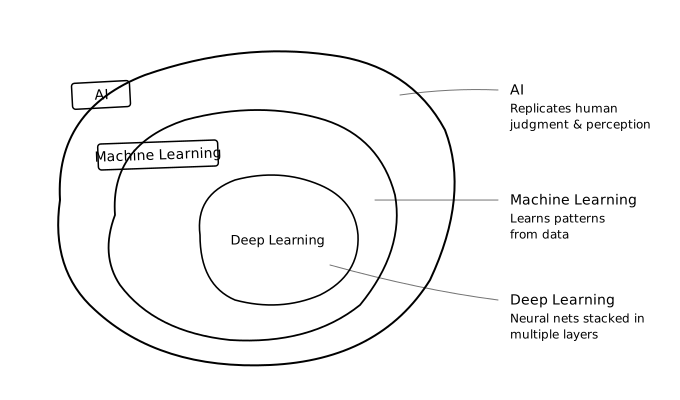
AI (artificial intelligence) is the broad field of making computers do the kinds of judging and perceiving that people used to do. Within that, machine learning is the approach of having a system find patterns on its own by looking at data, and deep learning is the subset that stacks multiple layers of neural networks to do it.
A model, simply put, is a function that takes an input and produces an output. Feed it a word and it spits out the next word; feed it an image and it says “cat.” What makes it different from a hand-written if-else is that its behavior is determined by a huge collection of numbers inside it — the parameters, or weights.
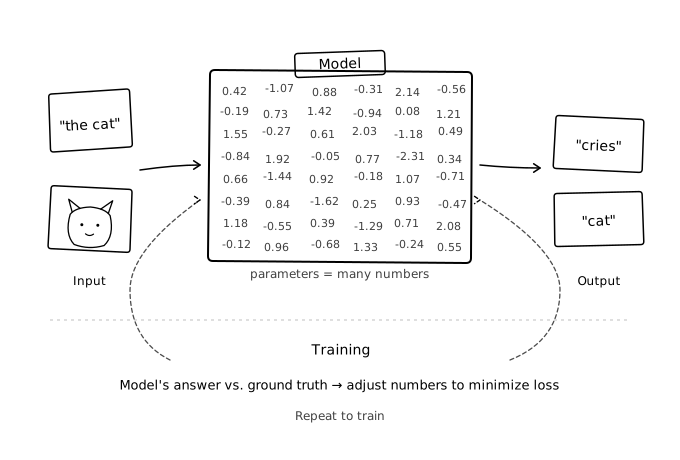
So how do those numbers get determined? That’s training. The most common form is supervised learning — showing the model a large pile of data with the correct answers attached.
But training can also work on data that has no labels at all. For example, you take a sentence from somewhere on the internet and ask the model, “what’s the next word in this sentence?” — the correct answer is already inside the data. This is called self-supervised learning, and it’s how the models we use every day — GPT, Claude — are trained.
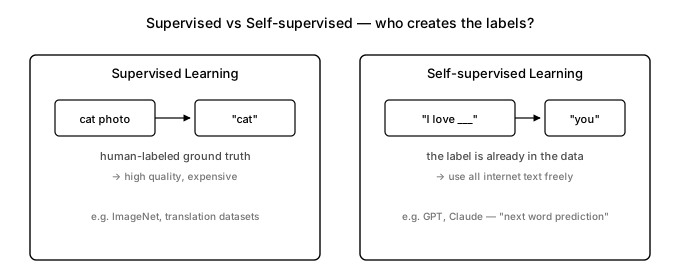
Beyond those two, there’s also unsupervised learning (which learns the structure of data without any labels) and reinforcement learning (which maximizes reward through trial and error).
Regardless of the approach, training is the repetition of one cycle: the model produces a prediction → the gap from the correct answer is quantified with a loss function → working backwards to calculate how much each parameter contributed to that gap (backpropagation) → nudging the weights W a little in that direction.
The mechanics of the loss function and backpropagation are substantial enough to deserve their own treatment — I plan to cover them in the next post, so here I’ll just keep the overall flow in mind and move on.
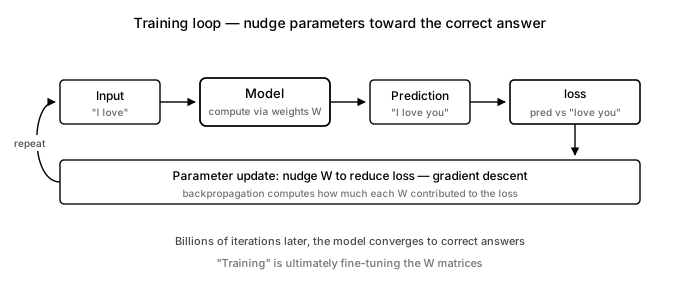
Run this cycle repeatedly and the model gradually learns the pattern: “for this kind of input, this kind of output is most likely.”
So when we say two models are different, we really mean the structure of the function that maps input to output is different.
AI Before Attention
Early neural networks were linear models — connecting input to output with a single straight line. Simple as that was, the limits were obvious: the patterns in the world are far too complex to be captured by a single line.
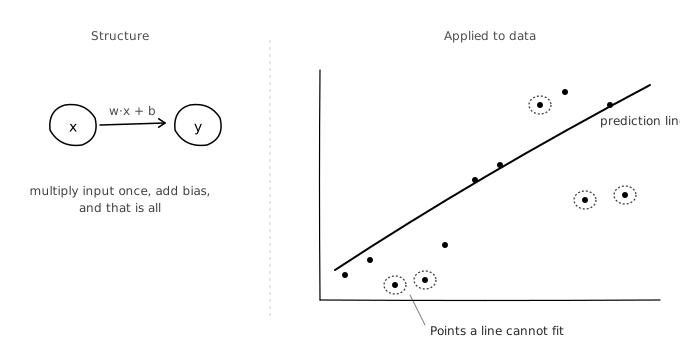
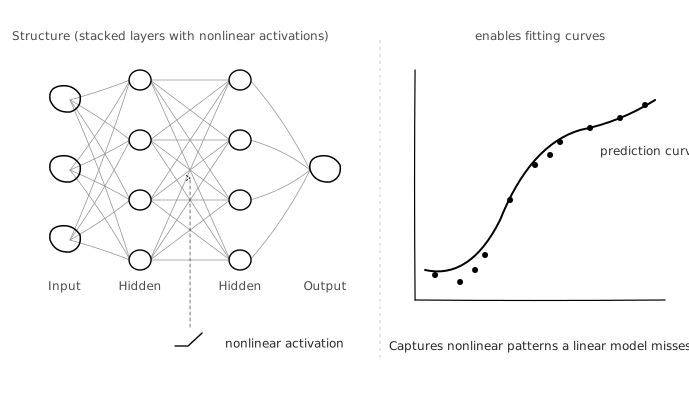
MLP (Multi-Layer Perceptron) addressed that. By inserting a nonlinear activation function between layers and stacking several of them, it became possible to learn curved patterns that a linear model never could. But MLP takes its input as a fixed-length vector all at once, so it couldn’t handle context across positions in ordered data — sequences like words or speech.
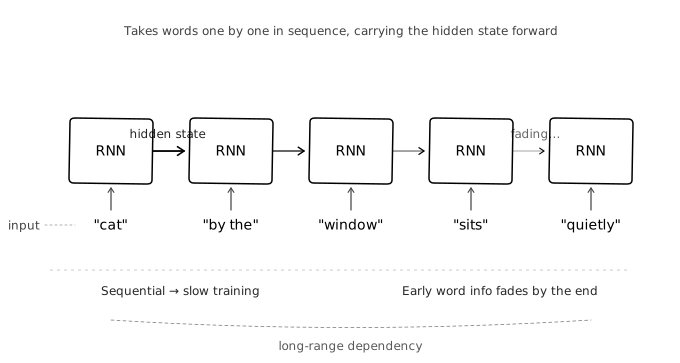
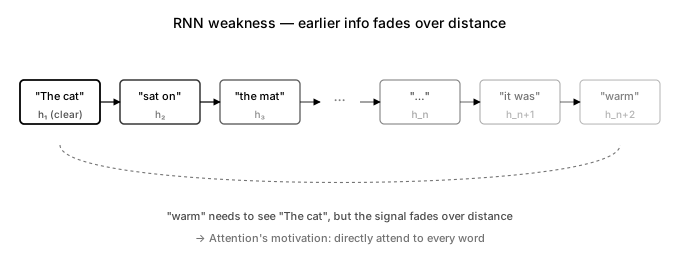
RNN (Recurrent Neural Network) solved that. By receiving words one at a time in order while carrying the previous hidden state along, it could handle context naturally. It wasn’t perfect, though — over long sentences the earlier information faded (the long-range dependency problem), and because it processed one step at a time sequentially, training was slow.
Around the same time there were attempts to handle sequences with CNN (Convolutional Neural Network). A filter — a small window that sweeps a few neighboring values at a time — slides across the input to catch patterns between nearby words, and it could be parallelized so training was faster. The catch was that the range it could see at once (its receptive field) was fixed, so to connect words far apart you had to stack many layers.
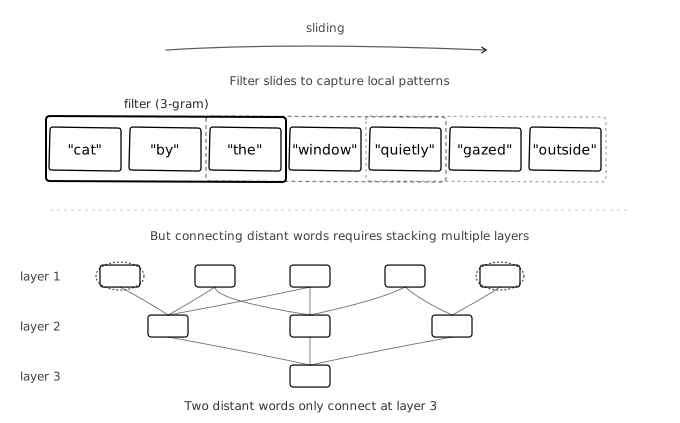
For different reasons — information fading in RNNs, limited reach in CNNs — both shared the same fatal weakness: difficulty connecting words that were far apart.
The Rise of Attention
As we just saw, RNN and CNN both struggled with relationships between distant words. Attention is the concept that emerged to solve this.
Reading the paper, I noticed that attention itself didn’t originate here.
Looking further, the paper that first introduced attention was Bahdanau et al., 2014. It was a proposal to attach attention as a supplementary tool on the side of an RNN seq2seq model, and it went on to be used in machine translation and similar tasks.
So what changed in “Attention Is All You Need”? It showed that attention alone — without RNN — could build the whole model. The model that came out of this is the Transformer.
However attention is used, the basic mechanism is the same, so let’s start there.
How Attention Works
Attention in one sentence: “a function that takes a query and a set of key-value pairs and maps them to a single output.” Query, key, value, and output are all vectors (bundles of numbers lined up in sequence).
Think of these three pieces — query, key, value — as a library:
- Query (Q) — “What information do I need?” The search term in the search bar.
- Key (K) — Each candidate’s label. The side that gets compared against Q.
- Value (V) — Each candidate’s actual content. Gets blended according to the weights to form the result.
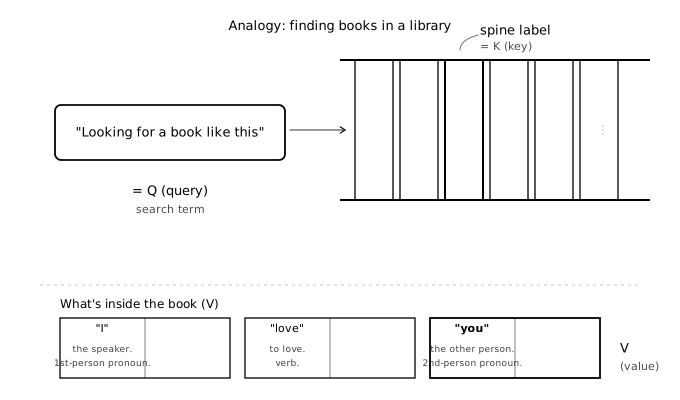
Simply put: attention is a function that lets the Query decide which candidates to weight, then blends the Values by those weights to produce an answer.
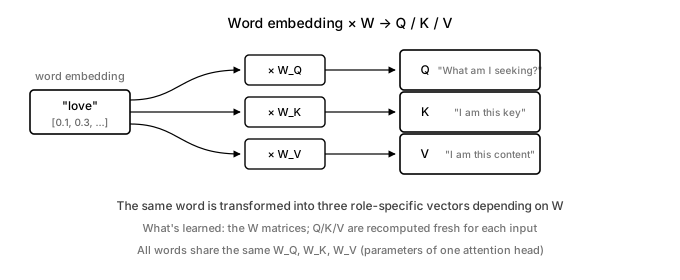
Where do Q, K, V actually come from? Each word has a word embedding — a vector that encodes the word as a meaningful set of numbers. For example: "I" → [0.1, 0.3, -0.2, ...]. Q, K, V are produced by multiplying that vector by trained weight matrices , , .
"I" vector × W_Q → Q for "I"
"I" vector × W_K → K for "I"
"I" vector × W_V → V for "I"start out random, but through training they settle into matrices that serve their respective roles (question / label / content). These three matrices are the core parameters attention learns through training — Q, K, and V themselves are recomputed from W each time a new input word arrives; what training fixes are the matrices.
Computing Attention
This looks intimidating at first, but it’s really just four steps in sequence.
1. — scoring. The dot product of Q with each K gives a similarity score. ( is the transpose, there to make the matrix dimensions line up for multiplication.)
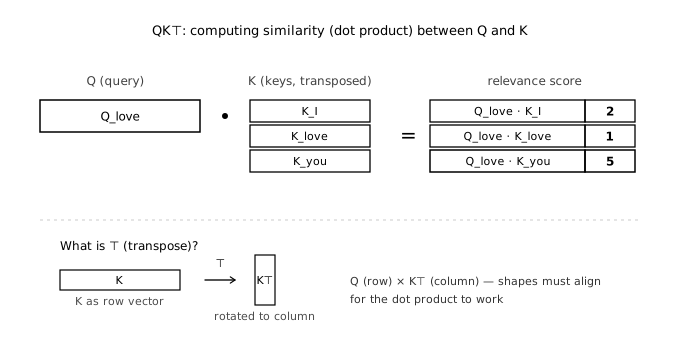
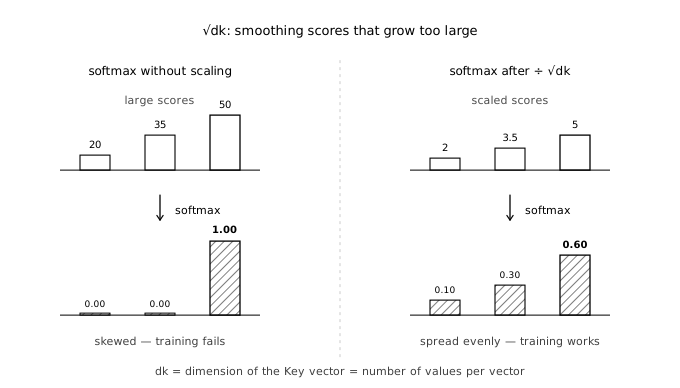
2. Dividing by — smoothing the scores. When (the Key vector dimension) is large, the scores naturally grow large too; if they get too large, the softmax in the next step collapses onto a single option. Dividing by is a correction that keeps the scores in check.
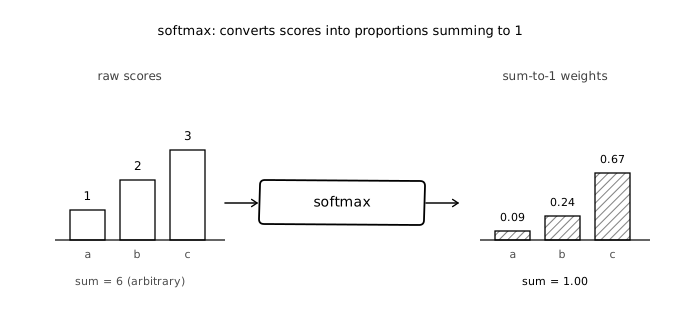
3. softmax — converting to proportions. The scores are turned into weights that sum to 1. Example: [1, 2, 3] → [0.09, 0.24, 0.67].
4. Multiplying by — weighted average. Those weights are used to blend the Values together into a single final output.
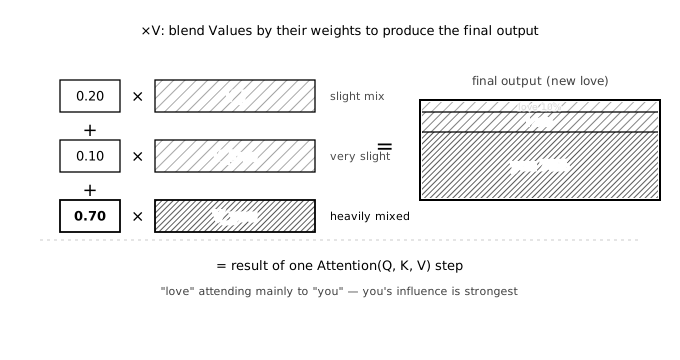
So what is this output vector? It’s the original word’s vector with the surrounding context mixed in. For instance, when “love” runs attention with Q in hand, the result is “love as seen alongside I and you.”
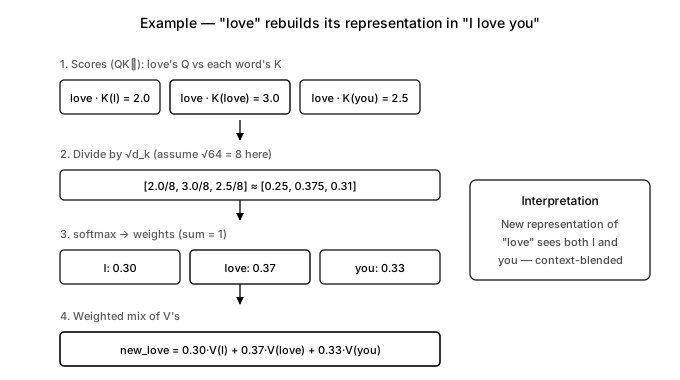
This output vector flows into the model’s next stage. Through several rounds of attention computation, the final desired output — a translated word, the next word in a sequence — is produced.
That’s the basic mechanics of attention.
RNN + Attention
Attention was first used in sequence-to-sequence (seq2seq) problems like machine translation. Looking at that setup makes it clear what problem attention was built to solve.
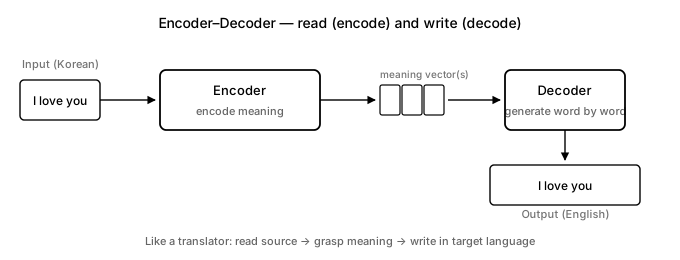
Encoder/Decoder structure. Tasks like machine translation are typically split into two pieces.
- Encoder — takes the input sentence (e.g., Korean) and converts it into meaning-bearing vectors.
- Decoder — takes those vectors and generates the output language (e.g., English), one word at a time.
Think of it as a translator who reads the original (encode), grasps the meaning, then writes it out in another language (decode).
The problem in the RNN era. When the Encoder was an RNN, it read Korean words one by one in order and updated a hidden state (a running summary of what it had read so far). After reading the last word, that single final hidden state was supposed to contain all the information from the entire Korean sentence, and only that one vector was passed to the decoder. The decoder would then produce English words one at a time from it.
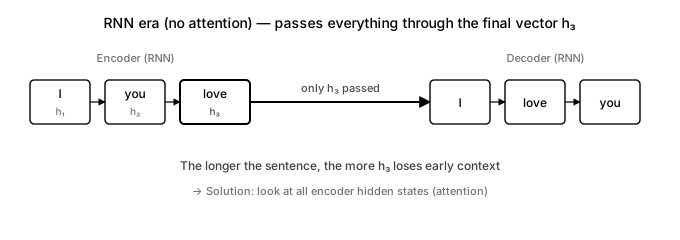
The problem: for long sentences, that one vector simply can’t hold everything. Early words fade, and the decoder loses track of which part of the original to look at.
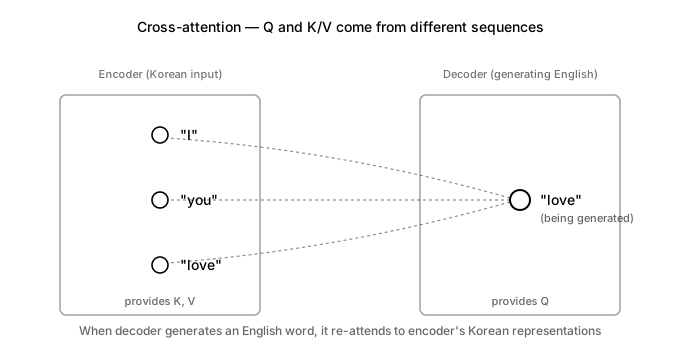
To fix this, Bahdanau et al. proposed attention as the solution. Each time the decoder produces an English word, it goes back and looks at all the word representations the encoder saw. Which one to focus on is determined by comparing Q and K.
- Q comes from the decoder side (the state of the English word currently being built)
- K and V come from the encoder side (the Korean word representations)
This form — where Q and K/V come from two different sequences — is called cross-attention.
Remaining limitation. Attention helped with distant words, but the RNN itself still processed words one step at a time in sequence. Training remained slow, and attention only kicked in after the hidden state had already been processed by the RNN.
At this point a natural question arises: could you drop the RNN and run on attention alone?
Attention Alone — The Transformer Proposal
That was exactly what “Attention Is All You Need” proposed. Remove the RNN entirely and run the whole model on attention. To do that, a new variant of attention and a few supporting pieces were needed. Let’s go through them one at a time.
(At the end of this section I’ll put all the pieces together in a single diagram, so don’t worry about perfectly understanding each piece as you go — just follow along.)
Self-Attention and the Masked Variant
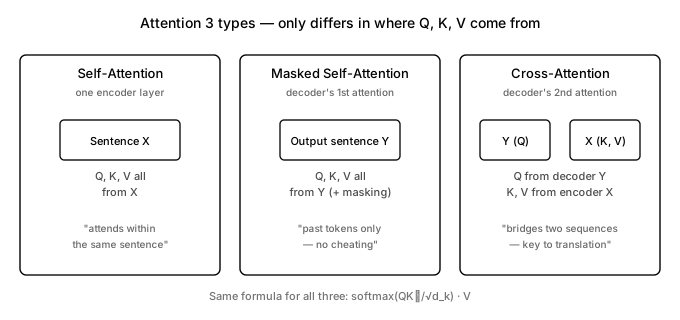
The attention form Transformer introduced is self-attention — where Q, K, and V all come from within the same sequence. (This is the counterpart to the cross-attention we saw in the RNN + Attention section.)
Say we want to enrich the meaning of “love” in “I love you.” “Love” holds the Q, while “I”, “love”, and “you” from the same sentence provide the K/V.
Q of "love"  ↔  K/V of "I", "love", "you"
              → new vector for "love"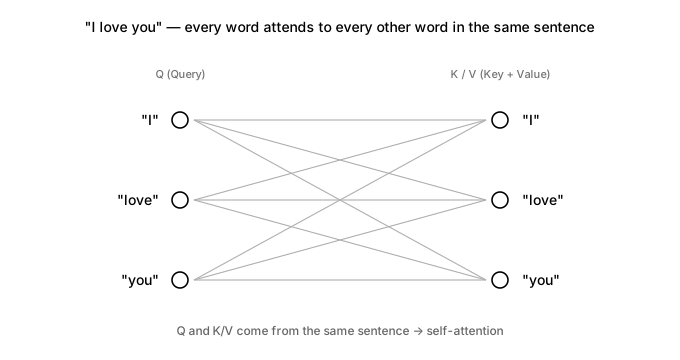
Masked self-attention — self-attention where you can’t see words that come after you.
This is used in the decoder when generating English. At the point of generating “love,” peeking at “you” — which hasn’t been created yet — would be cheating, so the scores for later words are blocked out (= masked).
Words visible when generating "love":  I, love
Words hidden when generating "love":   you ← masked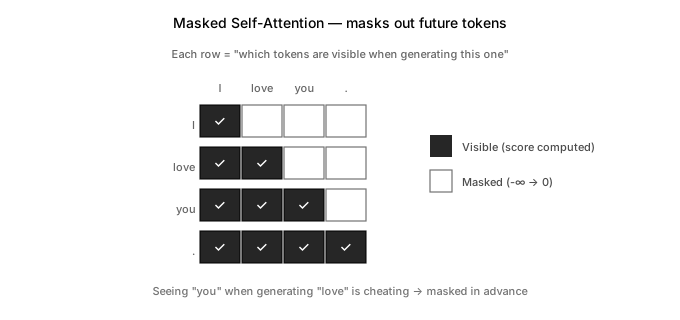
All three forms (self / masked self / cross) use the same computation — the only difference is where Q, K, and V come from.
Multi-Head Attention — Multiple Perspectives at Once
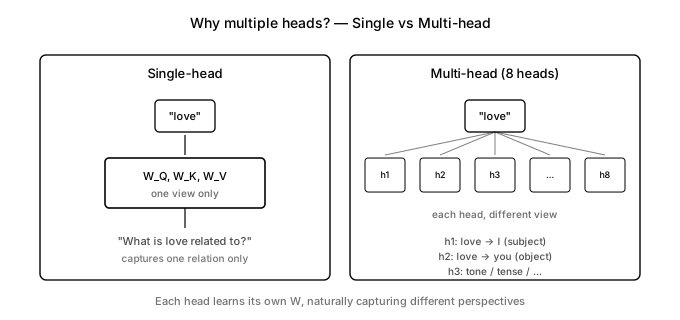
What we’ve seen so far is attention run just once. That means all words look at each other from a single perspective.
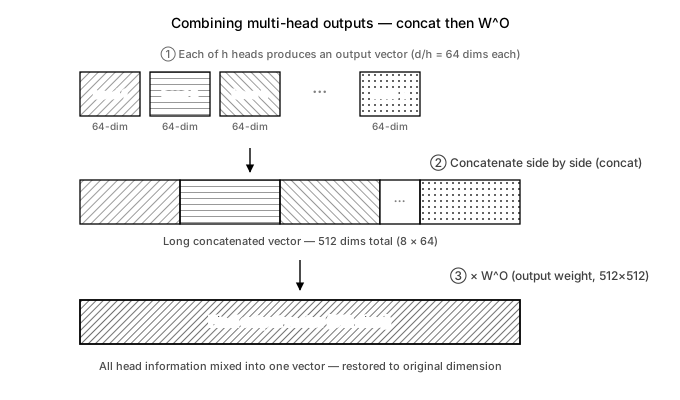
Transformer runs attention multiple times in parallel. Each head has its own weights , so each one looks at the words from a different perspective. If we look at “I love you” with 8 heads, for example:
- head 1 might weight the verb-subject relationship (“love” → “I”)
- head 2 might weight the verb-object relationship (“love” → “you”)
- head 3 might weight pronoun-neighbor relationships
Which head ends up doing what isn’t decided by the designer — it emerges naturally through training.
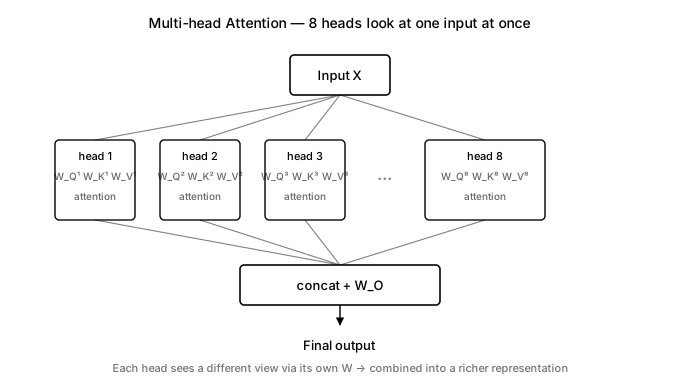
1. Each head runs attention with its own weights. Head multiplies the input Q, K, V by its own weight matrices to form that head’s Q/K/V, then runs the standard attention to get that head’s output vector.
2. The h heads’ outputs are combined and projected one more time. Running h heads in parallel produces h output vectors. Concatenating them side by side multiplies the vector dimension by h, so a final output weight matrix is applied to project everything back down to a single vector of the original dimension.
Transformer Block — FFN + Add & Norm
One layer of the Transformer doesn’t end with attention. An additional piece is attached, and both pieces are wrapped in a stabilizing mechanism.
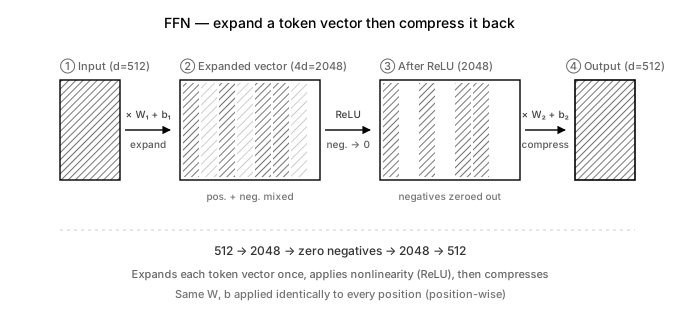
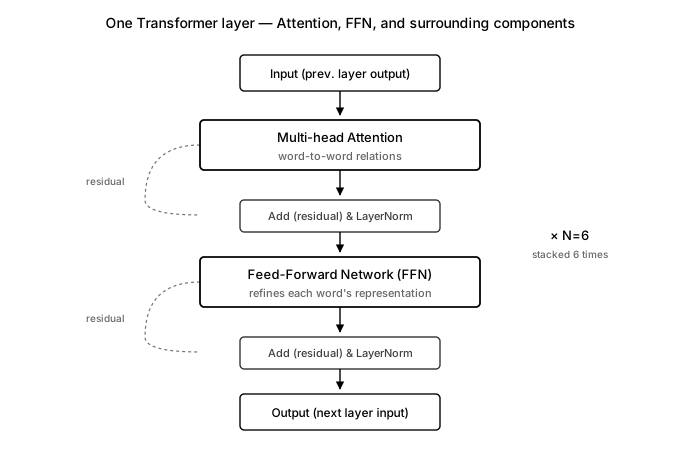
Each layer = Multi-head Attention + FFN (Feed-Forward Network), both wrapped in Add & Norm
Where attention captures relationships between words, FFN processes each word vector individually.
1. Expand. For one word vector (=512 numbers), multiply by weight and add bias to expand to a larger vector (=2048 numbers). The space to hold information is now four times wider.
2. Clip negatives to zero (ReLU). Every negative value in the expanded vector is replaced with 0. Simple as it looks, this single step is what lets the model learn curved, nonlinear patterns.
3. Compress back. Multiply once more by and add to compress back to the original size (=512). It’s the same size as before, but now it’s a new vector that has passed through the expansion and back.
(Biases are constant vectors added to the result of the weight multiplication — parameters determined by training alongside . They shift the result up or down, giving the model more expressive freedom.)
The same transformation is applied separately to each word vector (position-wise), so information doesn’t mix between words here — attention already handled that; FFN’s job is to refine each word individually as a follow-up step.
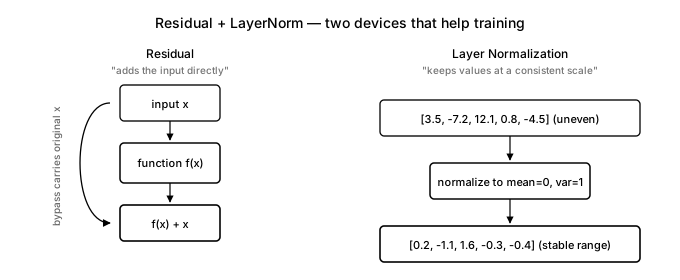
The Add & Norm mentioned earlier is shorthand for a pair — Residual connection and Layer Normalization — bundled together:
- Residual connection — adds the original input directly to the output. Even if the layer loses some information during transformation, the original survives alongside it.
- Layer normalization — re-centers the values after passing through a layer to mean 0, variance 1. If values grow too large or too small as layers stack up, training becomes unstable; this resets them every time to prevent that.
Both are worth a deeper look on their own, but for now knowing the name and role is enough to follow the rest.
This layer (MHA + FFN + Add & Norm) is stacked 6 times to make the encoder. The decoder follows the same pattern, but each layer gets an additional cross-attention block (the same form we saw in the RNN + Attention section).
(“6 times” is just the default setting the paper experimented with — it’s not fixed into the Transformer architecture itself. Later models use 12, 24, 96, or other layer counts depending on the task and scale.)
Positional Encoding — What About Word Order?
One question remains. Self-attention looks at all words simultaneously. So how does it tell word order apart? “I love you” and “you love I” mean completely different things, but with attention alone the two sentences would be processed identically.
The solution: encode which position each word is in as a vector and simply add it to the word embedding.
is the word embedding (encoding what the word is); is the position embedding (encoding which position it’s in). They’re the same dimension, so you just add them.
The position embedding is a fixed, unique set of numbers for each position. Position 0, 1, 2, … each have their own distinct pattern decided in advance, so when added to the word embedding the model can sense “this word is at position N.” (Specifically, they’re constructed by combining sine and cosine functions — there’s a deep reason for the exact formula — but in this post I’ll just capture the intuition; the detailed derivation is in Section 3.5 of the original paper.)
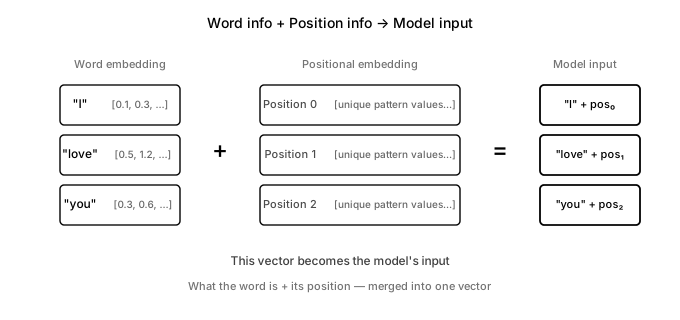
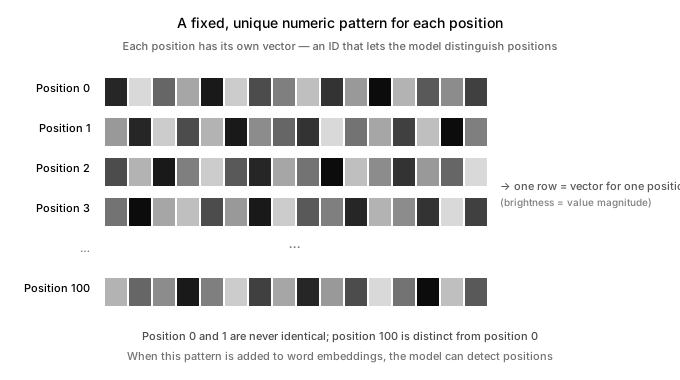
This one line () is what lets attention process word order information alongside word meaning.
The Full Picture — Putting the Parts Together
With the pieces we’ve covered, here’s what they look like combined. Let’s trace what happens all at once, using “Ich liebe dich” → “I love you” (German → English) as an example.
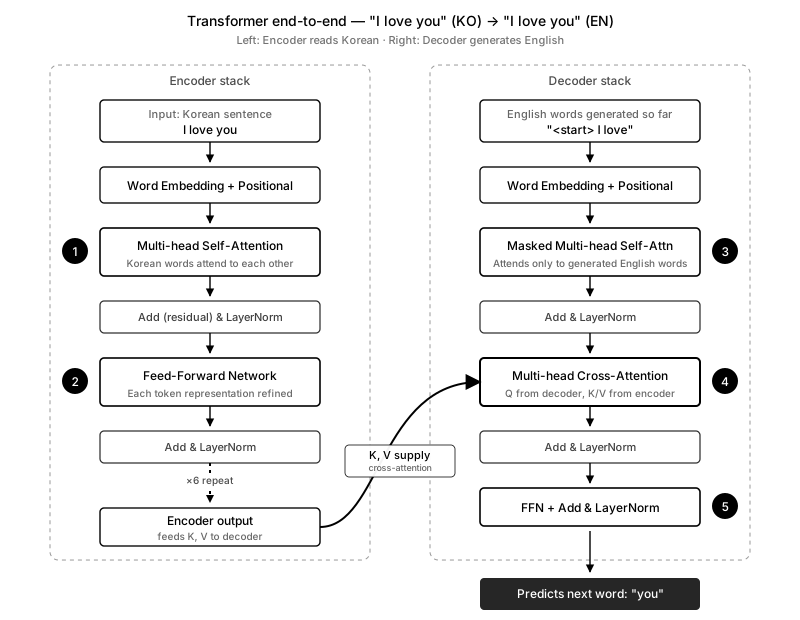
Left — Encoder (reading German). The German sentence “Ich liebe dich” arrives, and vectors are formed by adding word embeddings to position embeddings. Then:
- ① Self-attention: the German words attend to each other. The relationship “Ich is the subject of liebe” is captured here.
- ② FFN: each word representation is refined once more.
These two steps (+ Add & Norm) make one layer, and the same layer is stacked 6 times to build richer German representations. The final layer’s output is the German meaning vector — this is passed to the decoder as K and V.
Right — Decoder (generating English). The decoder generates English words one at a time. The English words generated so far (e.g., <start> I love) come in as input:
- ③ Masked self-attention: the English words attend only to each other. Words not yet generated are masked (= no cheating).
- ④ Cross-attention: this is the link between the two stacks. Q comes from the decoder (the current English state), K and V come from the encoder (the German representations). “What do I make after love?” — the English side asks the question, and the most relevant part of the German representations (“dich”) comes back as the answer.
- ⑤ FFN: one more pass of refinement.
These three steps make one decoder layer, and again it’s stacked 6 times. The last layer’s output predicts the next English word (“you”). That word is appended to the input and the whole process runs again to get the word after that, repeating until <end> appears.
Why Self-Attention?
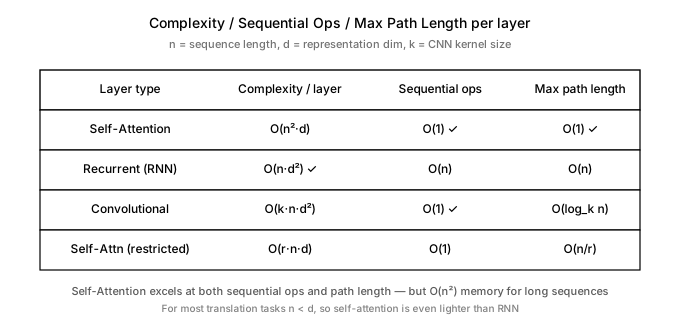
Before Transformer, the slot for processing sequences was occupied by RNN or CNN. Transformer puts self-attention there instead. Why? Two decisive advantages.
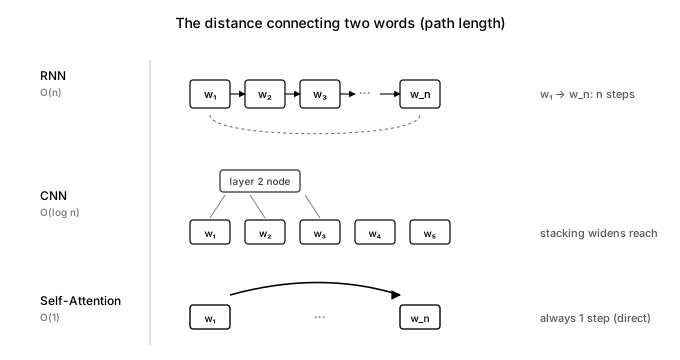
1. It connects distant words in a single step.
When you want to connect any two words in a sentence:
- RNN has to travel step by step across the distance between them. Connecting two words 100 positions apart requires 100 hidden-state updates, and information fades along the way.
- CNN is limited by a fixed receptive field; reaching far requires stacking many layers.
- Self-attention compares any two words directly in one shot. Whether the distance is 1 or 100, it’s always one step.
2. It processes all words at once.
- RNN has to process words one by one in order. n words means waiting n times.
- Self-attention can process all words in parallel, making training much faster.
How Much Better?
We’ve now seen why self-attention is theoretically appealing. Let’s take a quick look at what happened when the authors actually trained the Transformer and compared it against existing models.
Training
The authors validated the Transformer on machine translation — the standard benchmark for model comparisons at the time, which allowed direct comparison against the existing SOTA models based on RNN and CNN.
- Evaluation data: WMT 2014 — the standard dataset from the annual machine translation conference. Two tasks: English → German and English → French.
- Hardware: 8× NVIDIA P100 GPUs
- Training time: 12 hours for the smaller model (base), 3.5 days for the larger model (big)
Compared to the RNN-based top models of the time, which took anywhere from days to weeks, the Transformer finished in far less time.
Results
Translation quality is measured with BLEU — a score from 0 to 100 reflecting how much overlap there is between the model’s translation and a human reference translation. Higher is closer to the reference.
The Transformer set a new SOTA (State-of-the-Art) on both WMT 2014 tasks:
| Task | Previous best | Transformer (big) |
|---|---|---|
| English → German | 25.16 (ConvS2S, CNN-based) | 28.4 |
| English → French | 40.46 (ConvS2S) | 41.8 |
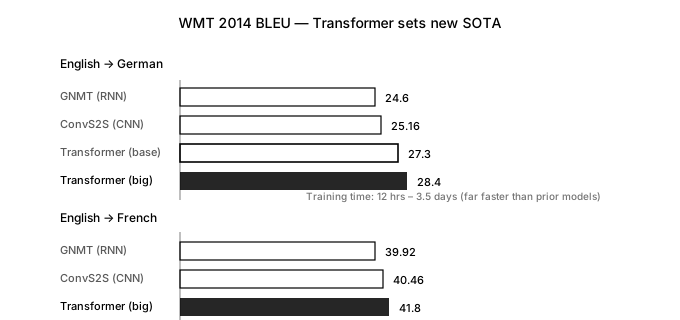
It outscored the previous best models and trained much faster. And it wasn’t just good at translation — it also worked on English constituency parsing (breaking a sentence’s grammatical structure into a tree), a task with a very different character. A model that generalizes beyond the task it was trained on was a meaningful signal.
What Came After
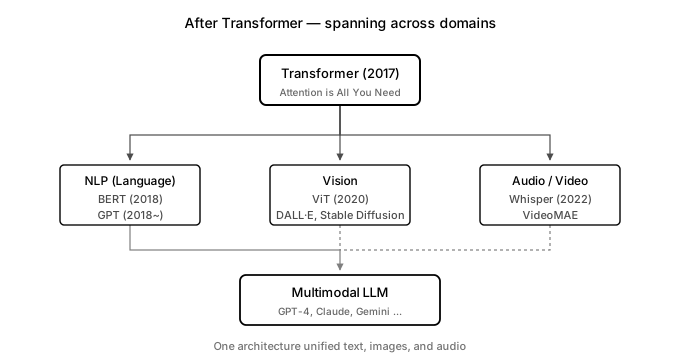
The paper’s authors closed by writing that they planned to extend Transformer to images, audio, and video. Within a few years:
- BERT, GPT (NLP)
- Vision Transformer (ViT) (images)
- Whisper (speech)
All built on the Transformer. ChatGPT, Claude, and Gemini — the models we use every day — are variations on the same core.
Wrapping Up
- The paper was challenging, but working through it slowly things gradually clicked, and writing it all out let me consolidate what I’d studied.
- It was satisfying to get a look at the structure underlying the models we use every day — GPT, Claude, Gemini.
- Next, I’d like to implement a small attention-based model in code, even a tiny one.
This post may contain factual or interpretive errors. If you spot anything wrong or have a question, feel free to leave a comment.
Reference
- https://arxiv.org/abs/1706.03762 — Vaswani et al. 2017, “Attention Is All You Need” (Transformer)
- https://arxiv.org/abs/1409.0473 — Bahdanau et al. 2014, the original RNN + Attention paper